
How Much Does a Nursery Renovation Cost in 2026?
A full nursery renovation cost breakdown for 2026: budget, mid-range, and high-end ranges, what drives the price, and how to plan the room before you spend.
RoomRenovation.AI Team
Updated June 11, 2026

A nursery renovation in 2026 costs less than most expecting parents fear and more than most interior design content suggests — the real range spans from a few hundred dollars for a thoughtfully curated refresh to $8,000–$15,000 for a fully custom-designed, professionally installed room. What you actually spend depends on four variables: the room's current condition, whether you need structural work, how much custom millwork or built-in furniture you want, and your local labor market. This guide breaks down each cost category honestly so you can budget for the nursery you actually want.
The Full Cost Breakdown
Paint: $150–$600
Painting a nursery is one of the most cost-effective and highest-impact changes in any room renovation. A standard 10x12 nursery requires approximately 2–3 gallons for two coats on the walls; at $60–$90/gallon for a low-VOC interior paint (Benjamin Moore Aura, Sherwin-Williams Harmony, or comparable low-emission options appropriate for infant spaces), material cost runs $120–$270.
Professional painting labor in a standard room runs $200–$400 depending on prep work required and your market. DIY painting is entirely manageable and saves the full labor cost. The design choice that most impacts cost: an accent wall or mural treatment (wallpaper, stencil, or hand-painted mural) adds $200–$1,500+ depending on complexity.
Current color trends for nurseries lean toward soft, nature-inspired palettes: dusty sage, warm clay, muted mauve, soft butter yellow, and cloudy gray-green rather than the baby-blue and pink pastels of previous decades. These colors age with the child and don't require repainting at the toddler stage.
Crib: $200–$2,500
The crib represents one of the nursery's largest single purchases and one of the few where safety standards make brand quality matter. JPMA-certified cribs from established brands are the minimum standard; all models sold in the US must meet current CPSC requirements for slat spacing and mattress support.
- $200–$500: Solid entry-level cribs from IKEA (SUNDVIK), Delta, and Graco. Functional and safe; typically convert to toddler bed. Minimal design presence.
- $500–$900: Mid-range convertible cribs from Babyletto, DaVinci, and Pottery Barn Kids. Better materials (solid wood or TSCA-compliant MDF), cleaner lines, more color and finish options. The Babyletto Hudson and DaVinci Fairway are perennial design favorites in this range.
- $900–$2,500+: Premium convertible cribs (Oeuf, Romina, Restoration Hardware Baby) in solid hardwoods with 4-stage conversion (crib → toddler → daybed → full-size) and refined design that doesn't announce "nursery" when the child outgrows it.

Crib Mattress: $120–$400
Don't underinvest here. A quality crib mattress affects infant sleep quality and safety in ways that justify the cost. The key specifications: firm (infants should not sink into a mattress), tight-fitting (no gap between mattress edge and crib rail), and low-VOC or GREENGUARD Gold certified (Newton, Naturepedic, Sealy Posturepedic). Budget $150–$300 for a mattress that meets these criteria.
Changing Table / Dresser: $200–$1,200
A dedicated changing table is a nursery-only purchase; a dresser with a removable changing topper serves the same function through infancy and remains useful after the child outgrows diapers. The Babyletto Hudson (6-drawer), IKEA HEMNES dresser with changing topper, and Pottery Barn Kids changing table are the most common mid-range choices ($350–$800). Built-in changing table with integrated storage as part of custom millwork runs $1,500–$3,500.
Glider or Rocking Chair: $250–$1,500
A glider chair for nighttime feeding and rocking is the piece of nursery furniture that adults use most — and will use for years beyond the nursing period. Don't compromise here for budget reasons. A chair that fails at the upholstery seams in six months, or that offers inadequate lumbar support for long feeding sessions, produces real daily discomfort.
HGTV and designer favorites in the $350–$700 range: Monte Design Joya, Pottery Barn Kids Upholstered Rocker, Storkcraft Tuscany. For $700–$1,500: Dutalier glider-ottomans and Nursery Works Sleepytime designs that use performance fabric and solid wood frames built to last beyond the nursery stage.
Lighting: $100–$600
Nursery lighting requires two modes: bright task light for diaper changes and feeding, and dim, warm nighttime light that doesn't fully wake a sleeping infant. This means a dimmable overhead fixture plus a warm-toned nightlight or low-power table lamp. A dimmable ceiling fixture runs $80–$300; a smart bulb upgrade to an existing fixture costs $15–$40 and provides full dimming and color temperature control via phone. A dedicated nightlight adds $20–$60.
Window Treatments: $100–$800
Light control in a nursery is a sleep-quality necessity, not a decorative extra. Blackout capability — either through blackout curtains, blackout cellular shades, or a combination — makes a measurable difference in nap consistency and early-morning sleep. IKEA MAJGULL blackout curtains ($25–$60/panel) are budget-effective and available in neutral colors. Custom Roman shades with blackout lining run $200–$400 per window; motorized blackout shades add $400–$800 per window but offer phone-controlled light management without disturbing a sleeping infant.
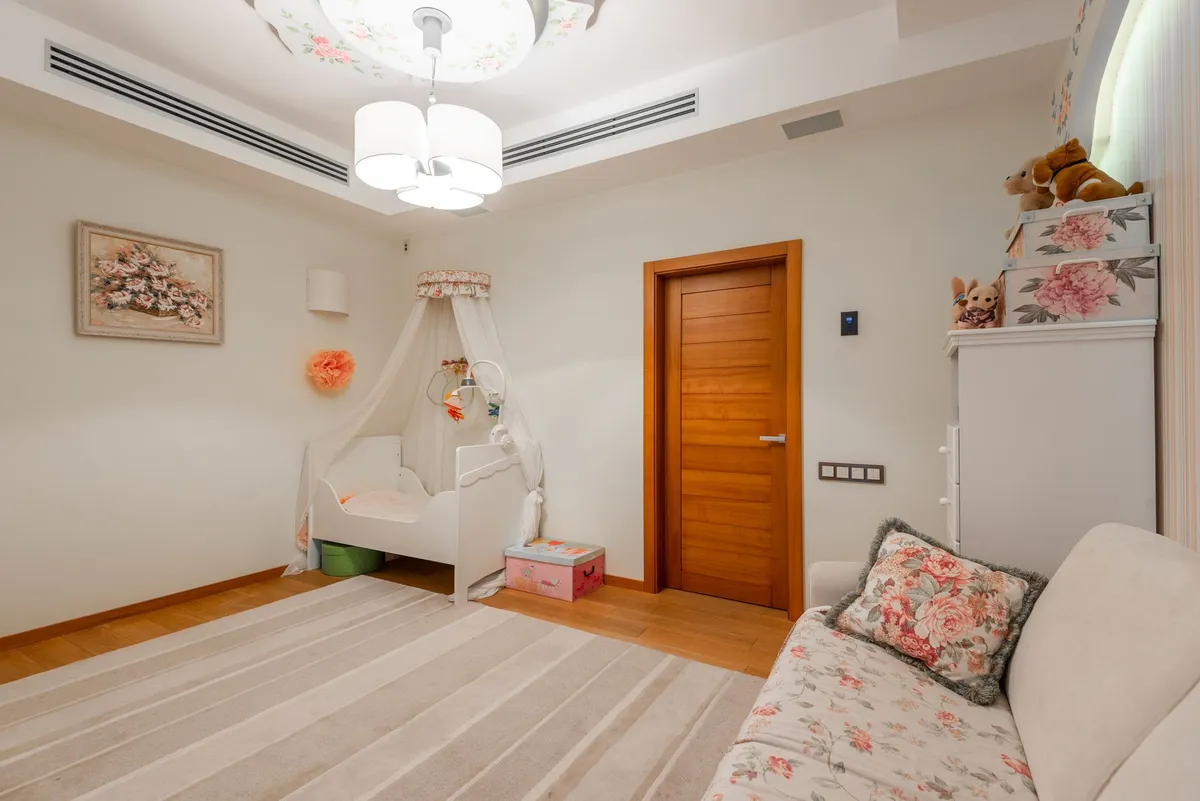
Flooring: $0–$4,000
If existing hardwood or LVP is in good condition, add an area rug ($80–$400 for a soft cotton or wool nursery rug) and you're done. If flooring needs replacement, luxury vinyl plank ($2–$5/sq ft) is the practical nursery choice: waterproof for the inevitable spill and diaper incidents, softer underfoot than hardwood, and durable enough to last through multiple childhood stages. Professional installation of LVP in a 12x12 room runs $600–$1,500 total (material plus labor).
Carpet in a nursery is softer underfoot but harder to clean and can harbor allergens — most pediatric health guidance favors hard floor plus washable rug.
Storage and Organization: $200–$2,500
Nursery storage requirements are underestimated by nearly every first-time parent. The quantity of items that accumulate — diapers, wipes, clothing in seven sizes, books, toys, swaddles, breast pump equipment, and every gift you've received — exceeds the storage capacity of most rooms as initially configured. Budget specifically for:
- Dresser (doubles as changing table): see above
- Bookshelf or wall-mounted shelving: $60–$300
- Closet organizer system: $150–$600 for a basic expandable system; $800–$2,500 for custom built-ins
- Toy/book bins for floor-level storage: $40–$150
Custom Millwork (Optional): $2,000–$8,000
Built-in shelving, a window seat with storage, or a custom changing station with integrated wardrobe are the highest-cost elements of a premium nursery. They also produce the highest visual and functional return, turning a generic room into a designed space that can evolve through multiple childhood stages. Local woodworkers and cabinet makers typically quote these projects in the $150–$250/linear foot range for installed cabinetry.
Total Cost by Tier
- Essential nursery, $800–$2,500: Budget crib + mattress, dresser with changing topper, basic glider, paint, blackout curtains, rug, and a nightlight. A safe, functional, pleasant nursery without design investment.
- Well-designed nursery, $3,000–$6,000: Mid-range convertible crib, quality glider, new flooring or LVP upgrade, quality window treatments, thoughtful lighting, and organized closet system. A room that's genuinely designed and will grow with the child.
- Premium nursery, $8,000–$15,000+: Premium convertible crib, custom millwork, professionally planned design, motorized shades, high-end lighting, custom wallpaper or mural, quality rug, and top-tier furniture throughout. A room worth photographing.
For detailed cost comparisons by room type, see the nursery renovation cost guide, bathroom renovation costs, and living room renovation costs.

Visualizing Before You Buy
Nursery design decisions are made under deadline pressure (a baby's arrival doesn't wait for contractor delays), which makes visualization before commitment especially valuable. Upload a photo of your current spare room to RoomRenovation.AI and preview how different design directions — Scandinavian, modern farmhouse, soft contemporary — would read in your actual space with your light. Seeing the palette and furniture arrangement in your real room helps you avoid costly color and style mistakes before ordering. The design dashboard provides the full style library for exploration.
FAQ
What's the biggest mistake parents make when budgeting for a nursery? Underestimating storage needs and spending the storage budget on aesthetics. A beautiful nursery that runs out of storage space within two months creates daily frustration. Budget for storage first, then allocate remainder to design elements.
Is a convertible crib worth the higher price? Yes, if you plan to have the child in that room through early childhood. A crib that converts to a toddler bed and then a full-size bed represents a 10–12 year furniture investment versus 2–3 years for a standard crib. The per-year cost of a premium convertible crib is lower than a budget crib replaced twice.
What are the safest paint choices for a nursery? GREENGUARD Gold certified paints with zero or ultra-low VOC are the safe choice. Allow at least 1–2 weeks of ventilation before the baby occupies the room. Benjamin Moore Aura, Sherwin-Williams Harmony, and ECOS Paints all meet this standard.
Should I hire an interior designer for a nursery? For a premium nursery ($8,000+), a designer who works with custom millwork and contractors can add significant value. For a well-designed nursery in the $3,000–$6,000 range, AI visualization tools plus the manufacturer design resources at Pottery Barn Kids, Babyletto, and comparable brands produce excellent results without designer fees.
When should I start the nursery renovation? Begin by the second trimester. Custom furniture, curtains, and built-ins can have 6–12 week lead times. Paint and furniture rearrangement can happen in the third trimester, but allow ventilation time before the baby's arrival.